
On this page
- What are screen and reverse-curve guards?
- How do they compare?
- Where do they make sense in Lincoln?
- How are they fitted?
- Guard terms
- What should I ask?
- Lincoln trees and guard choice
- Screens and hail
- Reverse-curve hoods and steep roofs
- Budget options
- Related reading
- Seasonal care for screen and hood guards
- When to choose screens over micro-mesh
What are screen and reverse-curve guards?
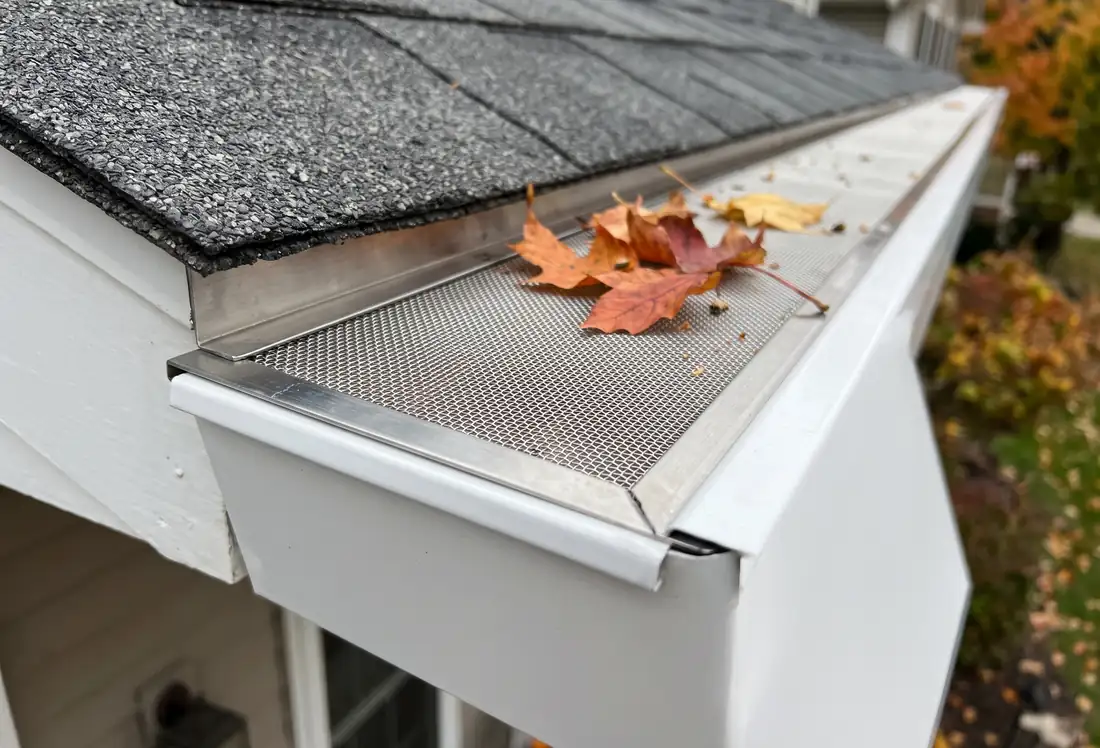
Screen guards are covers of perforated aluminum, steel or plastic, or expanded metal mesh, that sit over the gutter. Reverse-curve guards (also called hoods or helmets) are solid covers with a rounded nose; water clings to the curve and drops into a slot, while leaves slide off.
How do they compare?
| Screen | Reverse-curve | Micro-mesh | |
|---|---|---|---|
| Leaves | Stops | Sheds | Stops |
| Maple and elm seeds | Many pass | Some enter slot | Stops |
| Needles | Can poke through | Shed | Stops |
| Heavy rain on steep roofs | Good | Can overshoot | Good |
| Snow and ice | Holds snow | Slot can ice over | Holds snow |
| Cost | Lowest | Middle to high | Middle to high |
Where do they make sense in Lincoln?
- Screens: under big-leaf trees in autumn, on lower-pitch roofs, on a budget.
- Reverse-curve: where leaves are the main problem and roofs are not very steep.
- Micro-mesh: where seeds, needles and grit are the problem. See micro-mesh gutter guards.
How are they fitted?
- Repair and clean the gutters first.
- Fit screens to the gutter lip and under the drip edge or to the fascia.
- Fit hoods to the fascia and gutter, set to the roof pitch.
- Finish corners and ends.
- Test with water.
Guard terms
| Term | What it is |
|---|---|
| Screen guard | A perforated or expanded-metal cover with larger openings |
| Reverse-curve guard | A solid hood that relies on surface tension to curl water into a slot |
| Gutter insert | A foam or brush filler sitting inside the trough |
| Micro-mesh guard | A fine stainless mesh over a frame that blocks seeds and grit |
| Drip edge | Metal flashing at the roof edge that sends water into the gutter instead of behind it |
What should I ask?
- Which debris is this guard best at, and which does it let through?
- How does it handle heavy rain on my roof pitch?
- How does it attach?
- What happens with snow and ice?
Lincoln trees and guard choice
| Tree over the roof | Screen | Reverse-curve | Micro-mesh |
|---|---|---|---|
| Oak | Good | Good | Good |
| Silver or red maple | Seeds pass | Seeds enter slot | Best |
| Elm, hackberry | Seeds pass | Seeds enter slot | Best |
| Cottonwood | Fluff mats | Fluff in slot | Fluff mats |
| Pine, spruce | Needles poke through | Mostly shed | Best |
| Ash (dying) | Twigs and bark stopped | Shed | Stopped |
Screens and hail
Thin plastic screens can crack and aluminum screens can dent in hail. A dented screen still works if it sits flat. Ask how easily individual screens can be replaced.
Reverse-curve hoods and steep roofs
On steep roofs, water comes off fast and can jump the curve, especially in a thunderstorm. Hoods work best on moderate pitches. They also need the gutter set at the right height relative to the roof edge, which may mean re-hanging.
Budget options
Screens are the cheapest way to cut autumn leaf cleaning on one-story houses. Where spring seeds are the problem, the savings can disappear in cleaning seeds off and out of screens. Many homeowners spend more once and fit micro-mesh on the worst eaves only.
Related reading
Seasonal care for screen and hood guards
| Season | What to do |
|---|---|
| Late spring | Brush seeds off screens; check hood slots |
| Early summer | Clear cottonwood fluff |
| Autumn | Clear leaves sitting on top |
| Winter | Leave ice alone; watch for overflow at slots |
| After hail | Check for dented or cracked panels |
When to choose screens over micro-mesh
Screens make the most sense on one-story houses under big-leaf trees such as oaks, where autumn leaves are the problem and spring seeds are not. They cost less, are easy to lift for cleaning, and can be replaced panel by panel after hail. Under maples, elms and pines, the money is usually better spent on micro-mesh.