
On this page
- What are seamless gutters?
- Why do fewer joints matter in Lincoln?
- How are seamless gutters installed?
- Parts of a seamless system
- Which size and metal?
- What makes a seamless job last?
- What do seamless gutters cost?
- What should I ask?
- Common mistakes on seamless jobs
- Seamless gutters on different Lincoln houses
- When should I schedule?
What are seamless gutters?
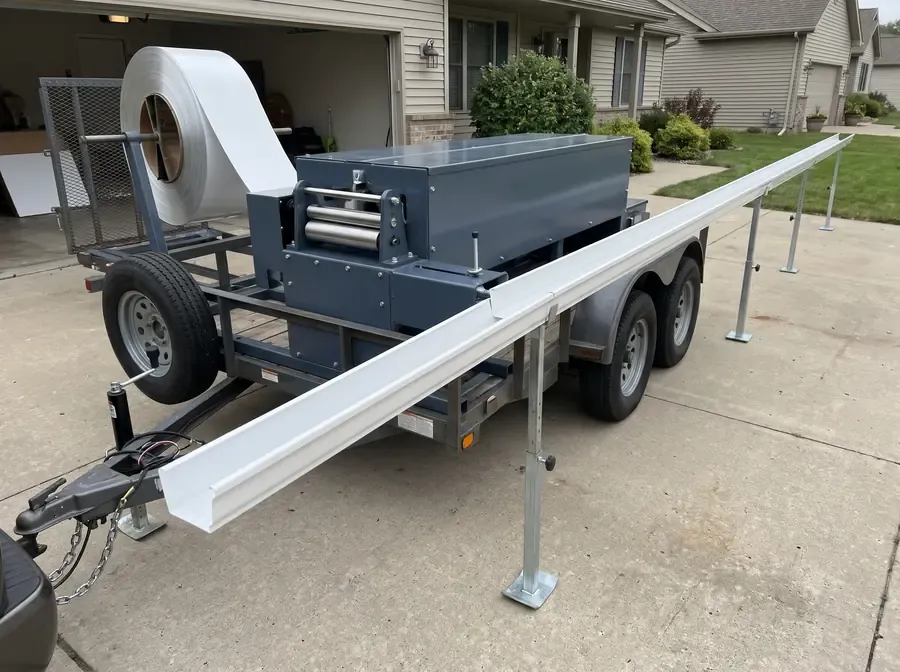
Seamless gutters are gutters formed at the house from a flat coil of metal, usually aluminum, by a roll-forming machine on the installer's trailer. Each run is cut to the exact length of the eave it will hang on, so a 42-foot eave gets a 42-foot gutter with no joints along it. The only joints in the system are the miters at corners, the end caps, and the outlets where downspouts attach.
Sectional gutters, by contrast, come in fixed lengths from a store and are joined with slip connectors and sealant every 10 or 20 feet.
Why do fewer joints matter in Lincoln?
Every joint is a strip of sealant holding two pieces of metal together. Sealant dries and cracks with sun and heat, and in winter water gets into the smallest gap, freezes, expands and opens it further. Lincoln's winters cross the freezing point again and again. A seamless run has only a handful of joints on a typical house; a sectional system can have dozens.
| Seamless | Sectional | |
|---|---|---|
| Joints along a run | None | Every 10 or 20 feet |
| Fit | Cut to each eave | Pieces cut and joined on site |
| Common leaks | Corners and end caps | Every slip joint plus corners |
| Sizes | 5-inch, 6-inch, some half-round | Mostly 5-inch |
| Installation | Specialist with a machine | DIY possible |
| Price | Higher per foot | Lower materials cost |
See the seamless vs sectional guide for more.
How are seamless gutters installed?
- Measure every eave and plan outlet positions and slope.
- Check fascia and drip edge; repair rotten boards first.
- Roll each run from coil to length on the trailer.
- Cut outlets and crimp end caps, sealed.
- Make miters at corners, as strip miters, box miters or hand-cut, and seal them.
- Hang on hidden hangers screwed into the fascia, usually about every 24 inches.
- Fit downspouts, elbows, straps and extensions.
- Test with water.
Parts of a seamless system
| Part | What it is |
|---|---|
| K-style gutter | The common flat-backed profile with an ogee front, in 5-inch and 6-inch |
| Hidden hanger | A bracket inside the gutter, screwed through the back into the fascia |
| Miter | A corner joint, inside or outside, made as a strip miter, box miter or hand-cut miter |
| End cap | The closed end of a run, crimped and sealed |
| Outlet | The opening (drop) where water leaves the gutter for the downspout |
| A and B elbows | Downspout bends: A elbows turn toward or away from the wall, B elbows turn sideways |
| Downspout strap | The band that holds the downspout tight to the wall |
| Drip edge | Metal flashing at the roof edge that sends water into the gutter instead of behind it |
Which size and metal?
Most Lincoln houses get 5-inch or 6-inch K-style in aluminum. Six-inch with 3x4 downspouts suits large or steep roofs and long runs; see 6-inch gutters. Standard aluminum coil is .027 inch; .032 dents less in hail and is stiffer between hangers. Colors are baked on, so the gutter does not need painting. See aluminum gutters.
What makes a seamless job last?
- Hanger spacing. Closer spacing at corners and under valleys, where snow and ice load the edge.
- Miters done carefully. Corners are the weak point of any seamless system.
- Slope. Enough fall that water does not stand and freeze in the trough.
- Outlets in the right places, with enough downspouts to keep each run short.
- Expansion. Very long runs may need an expansion joint or a center outlet.
What do seamless gutters cost?
National price guides from Angi and This Old House put seamless aluminum at about $9 to $13 a foot installed for 5-inch and $12 to $18 for 6-inch. These are national ranges, not local quotes. Number of corners, height, fascia repair and removal of old gutters all add. See the Lincoln cost guide.
What should I ask?
- What size, gauge and color are quoted?
- How are miters made and sealed?
- Hanger type and spacing?
- How many downspouts, where, and with what extensions?
- Is the old system's removal included?
Common mistakes on seamless jobs
- Too few downspouts. A seamless run can be long, but one outlet at the end of a 50-foot eave on a steep roof will overflow in a May storm. Two outlets, or a center outlet with slope both ways, keeps the load down.
- Miters left to sealant alone. Strip or box miters riveted and sealed outlast a corner that relies on a bead of caulk.
- Hangers into soft wood. Screws into rotted fascia feel tight on the day and pull out under the first ice load.
- Slope that holds water. A run set dead level, or with a dip in the middle, holds water that freezes overnight in winter.
- Discharge at the foundation. A new system that dumps every drop beside the basement wall moves the problem rather than solving it.
Seamless gutters on different Lincoln houses
| House | Typical seamless setup |
|---|---|
| 1950s–60s ranch, as in Eastridge | 5-inch K-style, 2x3 or 3x4 downspouts, long straight runs |
| Older two-story in Hartley or Clinton | 5 or 6-inch, more hangers on old fascia, careful drip edge |
| Newer two-story in Fallbrook or Waverly | 6-inch, 3x4 downspouts, many miters, upper roofs draining to lower |
| Acreage home near Malcolm or Raymond | 6-inch on long eaves, extensions well out into the yard |
When should I schedule?
Spring and autumn are the busiest seasons, and after a hailstorm demand jumps for weeks. Sealant cures best on dry metal above freezing, so many installers prefer to avoid the coldest weeks. If the old gutters are failing in autumn, it is worth booking before the ground freezes so downspout extensions and grading can be set too.